With the pandemic sidelining traditional sports, many sports broadcasters, in their scramble to find content to fill the void, turned to eSports. In place of staples like basketball and Formula 1, fans would find virtual versions of these traditional sports when they flipped on Sky Sports or ESPN.
Formula 1 in particular, was able to generate record breaking numbers with the virtual grand prix they hosted. The grand prix featured F1 drivers competing as well as a host of celebrities competing virtually through the official F1 game. In this way, fans were able to engage with not just the content, but the faces they’d grown familiar with, all the while being exposed to a new medium of entertainment.
A Juggernaut Continues To Grow
To be clear, eSports was a burgeoning money machine long before the Corona virus hit. A report by Influencer Marketing Hub shows that between 2016 and 2018, eSports viewership increased from 281 million to 380 million. The site projects that by 2021 this viewership will reach 550 million. But to really see the potential of eSports, we need to take a look at how the culture has exploded in the esports capital of the world, Korea.
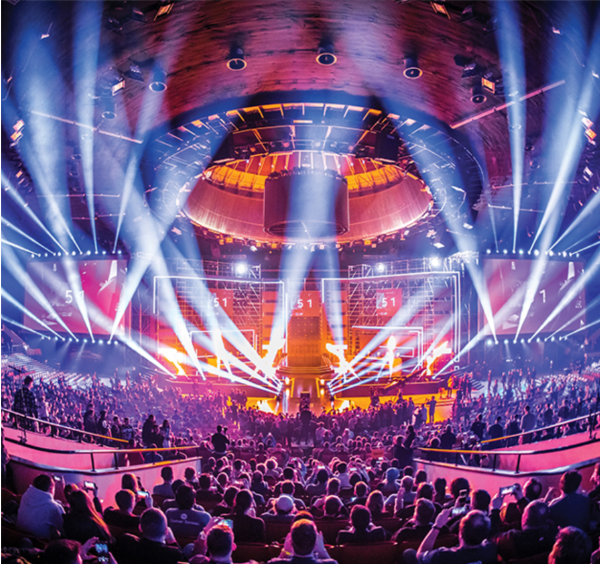
In Korea, eSports has permeated into the facets of quotidian life. In the same way that the baseball academies of yesteryear dot the sun dappled horizon of the Dominican Republic, eSports academies have popped up all over Seoul, looking to usher the next generation of digital athletes to success. Competitive events in the country routinely sell out arenas and are streamed to millions of viewers across the globe. This is due to the country investing in the eSports scene as early as 2000. But in the past few years, we’ve seen the hype around eSports expand beyond the borders of its capital and turn into a global phenomenon.
Launched in 2011, the Twitch streaming service averages about 35 million unique users a month. To put that in perspective, in 2019 ESPN Digital had its best year ever, receiving 95.5 million users per month. In addition to live coverage of eSports events, Twitch allows users to broadcast their own streams live to the public at any time. And with many professional gamers and eSports franchises on the service, it’s like having a backchannel to your favorite athletes.
And while it wasn’t too long ago that the popular image of a gamer was of a slacker, sat in an armchair in front of a glowing screen, today’s professional gamers are quickly changing that.
The Role of the Athlete in eSports
It might seem like a stretch to call professional gamers athletes. But just like the athletes in traditional sports, professional gamers have to undergo hours of training, strategy sessions, and the like all to be competition ready. Furthermore, from the financial side of things, becoming an eSports athlete can be incredibly lucrative.
In Seoul, events regularly sell out arenas, with grand prizes ascending into the millions of dollars. And just like their traditional sports counterparts, eSports athletes can command big money for exclusive contracts. Take professional gamer Tyler “Ninja” Blevins for example. After becoming the most popular user on the Twitch streaming service, the professional gamer made headlines when he signed a deal to stream exclusively on Microsoft’s Mixer service, a competitor to Amazon’s twitch.
As the market finds itself more and more saturated with streaming services and athletes become the faces of franchises and services, eSports are in a position to take the model of traditional sports and update it for a digital age. Digital arena’s and global live streaming gives eSports enthusiasts unprecedented access to the content and gamers they love, while at the same time bringing fresh demographics into the fold.
Advertising in eSports
For advertisers and brands looking to get in front of a new audience, the explosive growth of the competitive gaming scene offers an unprecedented opportunity. Viewership is up due to the global pandemic, and revenues are expected to reach 1.1 billion by the end of 2020. And while only a fraction of this comes from advertising, some major players have already jumped into the playing field.
Louis Vuitton and Nike have both gotten into the mix, and last year the aforementioned “Ninja” became the first eSports athlete to sign with Adidas. However, for most brands, the opportunity will lie in the eyes of both casual viewers and enthusiasts trained on the screen. Unlike traditional sports, the medium of video games lends itself to ads, pop-ups and banners mimicking the strobing HUD’s gamers have contended with for decades. And what’s more, there is no primetime. Sure, prestigious competitions draw droves of fans in bulk. But in the world of digital sports, there is always someone plugged in.
How eSports Is Changing The Game
In eSports we have found a medium that embraces traditional event spaces while, at the same time, transcending them. Yes, the draw of competitions has led to a rise in state-of-the-art eSports facilities being built, but the medium is not beholden to them. During the pandemic, when social distancing prohibited the gathering of large crowds, the industry was still positioned to deliver its content to the masses, with the digital arena proving to be largely pandemic proof.
In today’s world, our physical and digital lives are more intertwined than ever. Esports represents the culmination of that merger, with real people and real teams all competing on a digital platform before millions of fans. It is redefining what we consider to be an athlete.
Many professional gamers not only share the competitive spirit of their traditional counterparts, but also the rigors of competing on a professional level. But more than anything, eSports is changing the way we engage with the athletes and sports that we love.
We are able to connect at an unprecedented level in an environment where casual gamers, traditional athletes, and professional gamers are bonded by their love of competition. At a time when the physical connections we make are so very limited, eSports is showing us that our relationships to things and people we love can thrive at a digital level.
 SKIN1004 NYC launchTaking SKIN1004 to the streets: A citywide sampling experience driving buzz ahead of the NYC flagship opening.
 Persil x ArsenalBringing "Every Stain Should Be Part of the Game" to life.
 Stories.Quick, easy reads about things we’ve been thinking, feeling and analysing lately. Get scrolling to keep up.
 AI Shopping and Black Friday 2026: Why Credibility, Not Choice, Will Close the SaleAsk most brands what AI will change about Black Friday and you'll hear some version of the same story: the bots are coming for the basket. Shoppers will ask an assistant for the best deal, and the assistant will buy it for them.Read more