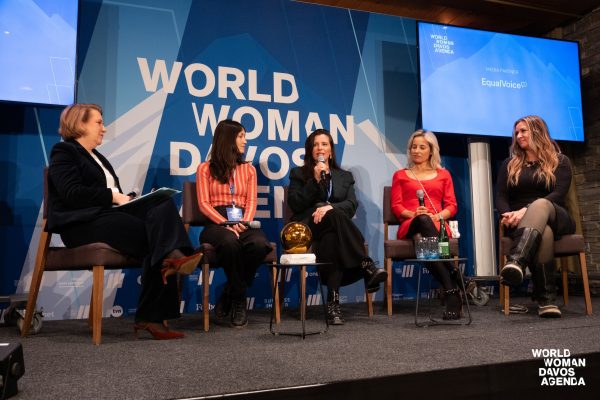
The Davos World Economic Forum has long been a stage for shaping global conversations on business, technology, and equality. Davos 2025 continued this tradition, sparking dialogues that went beyond policy to focus on real-world impact. Among the leaders at this year’s gathering was our very own Founder & CEO of MG Empower, Maira Genovese, who took part in the World Woman Foundation Davos panel “Creative Economy & Equality Moonshot” and was among the few Brazilians joining Davo’s packed agenda.
This discussion, alongside key moments across the World Economic Forum Davos 2025, shed light on the transformative power of the creative economy, gender disparity in leadership, and the role of emerging technologies in shaping a more inclusive future.
The creative economy as a catalyst for change
At the WWF Davos Agenda panels, one theme resonated across industries: the creative economy is no longer just a cultural force – it is an economic driver. Generating 6.1% of global employment, the sector plays a crucial role in job creation and business growth. However, systemic barriers continue to prevent marginalised groups from benefiting fully. Addressing these challenges requires stronger collaboration between governments, private sectors, and creatives themselves to ensure that economic opportunities are distributed more equitably.
Bridging the gender gap in creative industries
A core discussion at Davos 2025 centred on the persistent gender disparity in creative industries. The Global Gender Gap Report 2023 highlighted that while women represent 48% of the workforce, they continue to earn 25% less than men in equivalent roles. Additionally, leadership remains male-dominated, limiting opportunities for women to drive strategic decisions.
One of the most striking insights was that achieving gender parity in the creative economy could unlock $12 trillion in additional global GDP by 2030. Investing in female-led businesses isn’t just an ethical imperative—it’s an economic necessity.
Technology, storytelling, and inclusive growth
Technological advancements are reshaping the way narratives are told, offering unprecedented opportunities to amplify diverse voices. The WWF Davos Agenda explored how AI, blockchain, and digital platforms can democratise content creation and challenge traditional gatekeepers.
However, these advancements come with risks. AI, for example, is often embedded with biases that can reinforce stereotypes rather than break them. As Maira Genovese highlighted in her session, the creative industry is responsible for ensuring that emerging technologies are inclusive, representative, and used to drive equity rather than widen existing gaps.
The business case for investing in women
Despite the evidence that female-led businesses yield 25% higher returns than male-led ventures, investment in women entrepreneurs remains disproportionately low. The World Woman Foundation Davos panel reinforced the need for economic models prioritising equality, ensuring that funding flows toward businesses that bring social and financial returns.
From advertising and media to the broader creative economy, brands and investors must actively shift their strategies to empower underrepresented voices. A key takeaway? Diversity should not be an afterthought—it should be the foundation of all creative and business strategies.
Actions for the creative industry and beyond
Throughout Davos 2025, it became clear that real change requires more than just discussion—it demands action. Several strategies emerged for embedding inclusivity into the creative industries and beyond:
- Mentorship & Leadership Development – Establishing structured mentorship programmes to create clear career pathways for women and underrepresented groups.
- Inclusive Storytelling – Ensuring campaigns and content reflect diverse perspectives, not just in front of the camera but behind it as well.
- Equitable Compensation – Addressing the pay gap in creative industries, particularly in influencer marketing, where Black and marginalised creators often earn significantly less than their white counterparts.
- Empathy-Driven Campaigns – Moving beyond emotional appeal to human-centred marketing that actively challenges bias.
- Tech Accountability – Pushing for AI and digital tools that are free from bias and ensuring that emerging technologies do not perpetuate inequality.
As Maira Genovese noted, diversity is not just a social responsibility—it is a business strategy that drives better ideas, stronger connections, and greater impact.
Beyond Davos: The future of leadership & innovation
Insights from Davos 2025 extended beyond the creative sector, touching on leadership, data privacy, and the evolving role of technology in business. Some of the key discussions at the World Economic Forum Davos 2025 included:
- The Future of Leadership – A shift toward human-centred decision-making, where leaders must embrace experimentation and failure as part of the innovation process.
- Data & Cybersecurity – With creativity and technology becoming increasingly interconnected, data privacy is now a non-negotiable priority across industries.
- Social Media Disruptions – Recent changes, including Meta’s evolving platform strategies, are pushing businesses to redefine how they approach diversity, equity, and inclusion (DEI).
Final thoughts: From insight to action
As the discussions at Davos 2025 highlighted, the intersection of creativity, technology, and gender equity is where some of the most significant advancements—and challenges—of the coming years will emerge. The question is no longer whether diversity and inclusivity matter; it’s how quickly businesses will move to implement them as core strategic priorities.
At MG Empower, we believe in the power of creative industries to shape cultural narratives, challenge biases, and drive real economic impact. Through collaboration, innovation, and accountability, the insights from Davos World Economic Forum can translate into meaningful change—ensuring that creativity remains a force for progress, not exclusion.
If you’re looking to explore how these insights apply to your brand and how you can drive meaningful impact through creativity, get in touch with our team today.
 SKIN1004 NYC launchTaking SKIN1004 to the streets: A citywide sampling experience driving buzz ahead of the NYC flagship opening.
 Persil x ArsenalBringing "Every Stain Should Be Part of the Game" to life.
 Stories.Quick, easy reads about things we’ve been thinking, feeling and analysing lately. Get scrolling to keep up.
 AI Shopping and Black Friday 2026: Why Credibility, Not Choice, Will Close the SaleAsk most brands what AI will change about Black Friday and you'll hear some version of the same story: the bots are coming for the basket. Shoppers will ask an assistant for the best deal, and the assistant will buy it for them.Read more